The kasavu is not just a saree. It is the saree — the one worn once a year, pulled out with care, pressed with attention, and expected to carry the weight of the occasion without a single adjustment needed.
What goes underneath it deserves the same attention.
The Detail Every Other Guide Misses
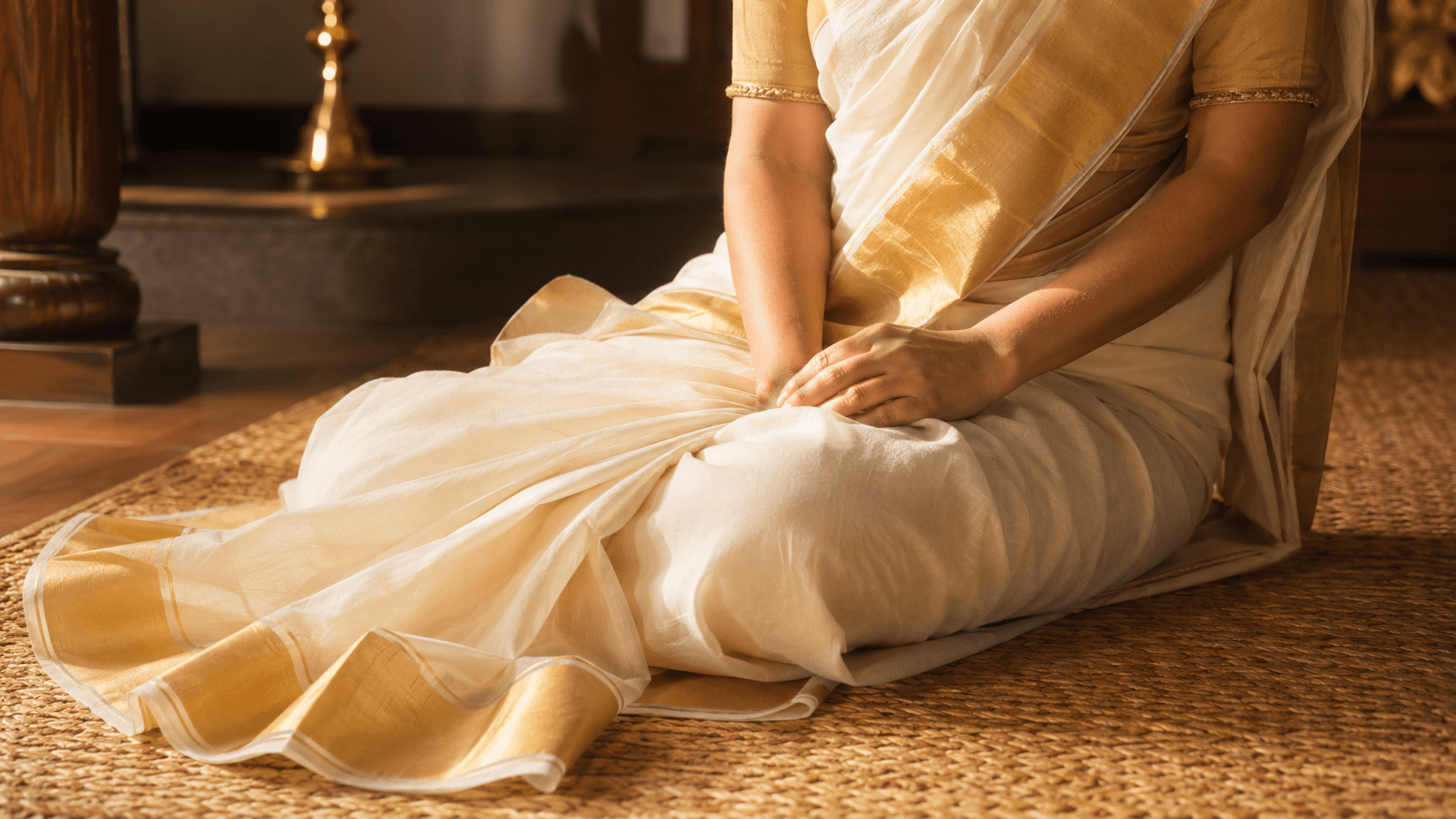
The Onam sadya is eaten seated on the floor, on a mat, in front of a banana leaf. The position — cross-legged, or leaning slightly forward — compresses the waist and abdomen in a way that standing, or sitting on a chair, simply does not. A shapewear waistband that holds perfectly while you are greeting guests will press painfully into the natural waist the moment you sit down for the sadya.
This is a specific failure with a specific cause. Shapewear with a rigid waistband cannot distribute the forward pressure of floor-sitting — it concentrates it. A reinforced waistband that retains some elasticity distributes that pressure instead, which is the difference between a comfortable sadya and one spent waiting for the meal to be over.
No other shapewear guide addresses this. It is the most important thing to know before choosing what to wear under a kasavu.
What the Kasavu Requires — The Short Version
For readers who want the answer before the explanation, here it is. Five requirements, all specific to the kasavu and the Onam day.
1. High waist, not mid or low.
The shapewear must sit at petticoat height — the natural waist. Anything lower sits in the wrong place for the kasavu drape and will not hold during the sadya position.
2. A reinforced but flexible waistband.
Reinforced so it does not roll. Flexible so it does not create a pressure point when you sit on the floor for the sadya. A rigid waistband fails the second requirement. An unreinforced waistband fails the first.
3. Breathable fabric — not synthetic-only.
Onam falls in early September in Kerala. Humidity runs between 80 and 90 percent through a celebration day of eight to ten hours. Shapewear that does not breathe becomes the primary thing you are thinking about by the sadya. The fabric must move moisture and allow air circulation.
4. Seamless or flat-seam construction.
The kasavu — particularly tissue and pure silk variants — reveals what is underneath it. Raised seam edges show as faint ridges through the fabric, especially in photographs taken in natural light. Seamless construction eliminates this variable entirely.
5. Skin tone, not white.
The kasavu is white or cream. The instinct is to wear white shapewear underneath. This is wrong — white shapewear under a white saree photographs as a distinctly visible separate layer. Match your skin tone, not the saree colour.
The Kasavu Is a Specific Problem
Most guides about what to wear under a saree treat all sarees as roughly the same. They are not. The kasavu — Kerala's traditional white and gold saree — presents a specific set of requirements that no generic shapewear guide addresses.
The fabric behaves differently.
The kasavu comes in three distinct versions, and each one changes what you need underneath.
The foundational, original kasavu is pure cotton — an unbleached off-white body with a gold zari border, lightweight and breathable, the standard choice for daytime Onam celebrations and temple visits.
Pure silk kasavu is heavier and more premium — woven entirely from silk yarns with a rich gold border, typically chosen for bridal occasions or grand evening receptions rather than the daytime sadya.
Tissue kasavu sits between the two: not a separate fabric, but a weaving technique — fine silk threads interwoven with metallic gold zari across the entire body of the saree, creating a translucent all-over shimmer. Lighter than pure silk, more structured than cotton, and the most demanding of the three for what sits beneath it.
Each drapes differently, weighs differently, and reveals different things about the base layer underneath.
The draping style sits differently.
The traditional Kerala style — mundum neriyathum — is a two-piece draping where the lower piece wraps differently than a nivi drape. Even when the kasavu is worn in the nivi style, as is increasingly common for Onam, the waist positioning tends to sit slightly lower and the pleats are fewer than a typical Kanchipuram or Banarasi saree. This changes where the shapewear needs to anchor.
The day is long.
Thiruvonam — the main day of Onam — begins in the morning with puja, moves into the sadya around midday, continues through family time in the afternoon, and for many households extends into an evening gathering. Eight to ten hours is not unusual. The base layer must hold for the full duration, through every part of that day.
The weather is specific.
Onam falls in early September in Kerala. The southwest monsoon is still present. Humidity runs at 80 to 90 percent. Temperatures sit between 27 and 30 degrees. This is not the controlled environment of an air-conditioned Mumbai wedding hall. It is warm, humid, and wet — and the celebration does not pause for discomfort.
Which Kasavu Changes What You Need
The three versions of the kasavu have meaningfully different requirements for the base layer.
Pure cotton kasavu
The most forgiving of the three — and the most common choice for the daytime Onam sadya. Cotton breathes well on its own, making it the most tolerant of September humidity. The fabric has enough body that minor shapewear irregularities are less visible than with the shinier variants. The primary requirement is breathability in the shapewear — cotton over a breathable base layer is a comfortable, manageable combination for a full day. The reinforced-but-flexible waistband requirement remains for the sadya position.
Pure silk kasavu
The heaviest and most demanding over a full day. The weight of pure silk creates downward pull on the drape as the hours pass — a stable, firmly holding base layer matters more here than with cotton. The fabric is less transparent than tissue but pure silk does reveal shapewear construction in photographs and at close range, so seamless or flat-seam construction still matters. Breathability in the shapewear is critical — heavy silk over non-breathable synthetic shapewear in September humidity is genuinely uncomfortable by the afternoon. This version is most commonly worn for evening or bridal occasions rather than the daytime sadya, so duration may be shorter — but the waistband flexibility requirement for any floor-sitting remains.
Tissue kasavu
The most demanding case for the shapewear. Tissue — the interweaving of silk and metallic zari threads — creates a translucent, shimmering fabric that reveals everything beneath it. Any raised seam at the edge of the shapewear will show as a faint ridge through tissue, particularly in natural light and photographs. Only seamless or laser-cut shapewear with no raised edges performs invisibly under tissue. Compression should be light to medium — heavy compression fabrics are often thicker and their texture can show through very fine fabric. Despite being lighter than pure silk, tissue provides almost no insulation from body heat, making breathability just as important.
The Petticoat System
The shapewear and petticoat work together. The shapewear provides compression and stability; the petticoat provides the drape surface for the kasavu. They must work without competing against each other.
For a kasavu, petticoat colour matters more than it does for darker sarees. A white or ivory petticoat in a fabric that doesn't add bulk — satin or silk rather than cotton — allows the kasavu to drape correctly. A cotton petticoat adds texture that can show through the saree.
The petticoat drawstring and the shapewear waistband should not both be applying maximum pressure at the same point on the natural waist. The shapewear holds; the drawstring secures the petticoat with enough tension to keep the drape in place, not enough to add a second layer of constriction at the same point. This pressure-stacking becomes particularly relevant during the sadya, when both are pressing against the bent-forward waist simultaneously.
For the Ten-Day Celebrations
Onam is not one day — it is ten, from Atham to Thiruvonam. The requirements shift.
Thiruvonam (the main day)
The full set of requirements applies: high waist, breathable fabric, seamless construction, reinforced-but-flexible waistband, skin-tone match. This is the day with the sadya, the longest wear, and the most photographs. The five requirements listed earlier are not optional on Thiruvonam.
Other celebration days
Duration is typically shorter and the occasion less formal. For family gatherings on Ashtami or Navami wearing a kasavu, the requirements are the same in kind but the stakes are lower. A comfortable, broadly correct option is acceptable when you are not sitting on the floor for a full sadya.
For women wearing a kasavu for the first time
The same rules apply — if anything, the waistband flexibility requirement matters more. A first-time kasavu wearer is less familiar with how the draping sits and will be more attentive to what is happening underneath during the sadya. The last thing that attention should land on is an uncomfortable waistband.
What Not to Wear
A standard petticoat alone.
A petticoat provides the drape surface but no compression or stability. For a full Thiruvonam day, the saree shifts more than it would with a stable base layer. The constant small adjustments you make throughout the day are the adjustments the base layer was supposed to eliminate.
Synthetic-only shapewear.
In September humidity, synthetic fabric that doesn't breathe becomes uncomfortable within two to three hours. By the sadya, the discomfort is significant. By the afternoon, it is the dominant experience of the day.
Maximum compression styles.
Heavy compression feels supportive when you first put it on. After six hours of sitting, standing, bending for the sadya, and moving through a full celebration day, maximum compression becomes maximum discomfort. Firm and correct outlasts tight and restrictive at this duration.
Anything with a rigid waistband.
For the sadya specifically, a rigid waistband creates a concentrated pressure point at the natural waist during floor-sitting. The shapewear must hold — not cut in — when you lean forward over the banana leaf.
White or black shapewear.
Under a white or cream kasavu, white shapewear photographs as a visible separate layer. Black shapewear shows as a shadow through lighter fabric. Neither is the right choice. Skin tone is.
Frequently Asked Questions
What do you wear under an Onam saree?
High-waist, breathable shapewear with seamless or flat-seam construction and a reinforced but flexible waistband. The kasavu is worn for a full day including the sadya — eaten seated on the floor — which requires a waistband that holds without creating a pressure point when the body bends forward. Breathable fabric is non-negotiable in September's warm, humid, and wet conditions.
What is the best shapewear for a kasavu saree?
Seamless, high-waist shapewear in a breathable fabric with a flexible reinforced waistband — for all three versions of the kasavu. For tissue kasavu, the shapewear must be ultra-thin with no raised seam edges, as tissue is semi-transparent and shows construction beneath it. For pure silk kasavu, standard seamless compression with firm hold works well but breathability remains critical. For cotton kasavu — the classic daytime Onam choice — breathable shapewear with a reinforced flexible waistband is the primary requirement, with seam visibility being less of a concern than with the shinier variants.
Can you wear shapewear under a Kerala saree?
Yes — and for a full Onam day, a stable base layer makes the kasavu significantly more comfortable to wear. The combination of high-waist breathable shapewear and a well-tied petticoat keeps the drape in place through the morning puja, the sadya, and the afternoon celebrations without the need for constant adjustment.
What petticoat is best for a kasavu saree?
A white or ivory satin or silk petticoat — not cotton, which adds texture visible through the kasavu. The petticoat should sit at the natural waist at the same height as the shapewear waistband. The drawstring should secure the drape without adding a second layer of pressure on top of the shapewear waistband at the same point — pressure-stacking at the natural waist is particularly uncomfortable during floor-sitting.
Why does shapewear roll during the sadya?
The sadya position — seated on the floor, leaning slightly forward over the banana leaf — compresses the waist and torso differently than chair-sitting. Shapewear with an insufficiently reinforced waistband rolls under this pressure. Shapewear with a rigid waistband digs in instead. A waistband that is reinforced but maintains some elasticity distributes the pressure rather than concentrating or yielding to it.
Does shapewear show under a white kasavu saree?
It can, depending on the kasavu variant and the shapewear construction. Tissue kasavu is the most demanding — its translucent, shimmering weave shows raised seam edges, textured fabric, and waistband ridges clearly. Pure silk kasavu is slightly more forgiving but seam edges show in photographs. Cotton kasavu is the most tolerant. Across all three, seamless or laser-cut shapewear in a skin tone that matches your complexion performs best. Avoid white shapewear under a white kasavu — it photographs as a distinctly visible layer.
How long can you comfortably wear shapewear under a kasavu?
With the correct shapewear — breathable fabric, correct sizing, flexible reinforced waistband — a full Thiruvonam day of eight to ten hours is manageable. The key variables are breathability (synthetic fabrics become uncomfortable faster in humidity), correct sizing (too small creates discomfort that compounds across hours), and waistband construction (rigid waistbands create pressure points during the sadya floor-sitting position).
What size shapewear should I wear under a kasavu?
Your correct size based on your natural waist and hip measurements — not a size smaller. Under a kasavu for eight to ten hours including floor-sitting for the sadya, shapewear that is too small creates discomfort that becomes increasingly difficult to ignore. Correct sizing holds firmly and comfortably without restriction. See our sizing guide for how to measure correctly.
Read next: What to Wear Under a Kanchipuram Silk Saree · Can You Wear Shapewear Under a Saree? · How to Choose Your Saree Shapewear Size