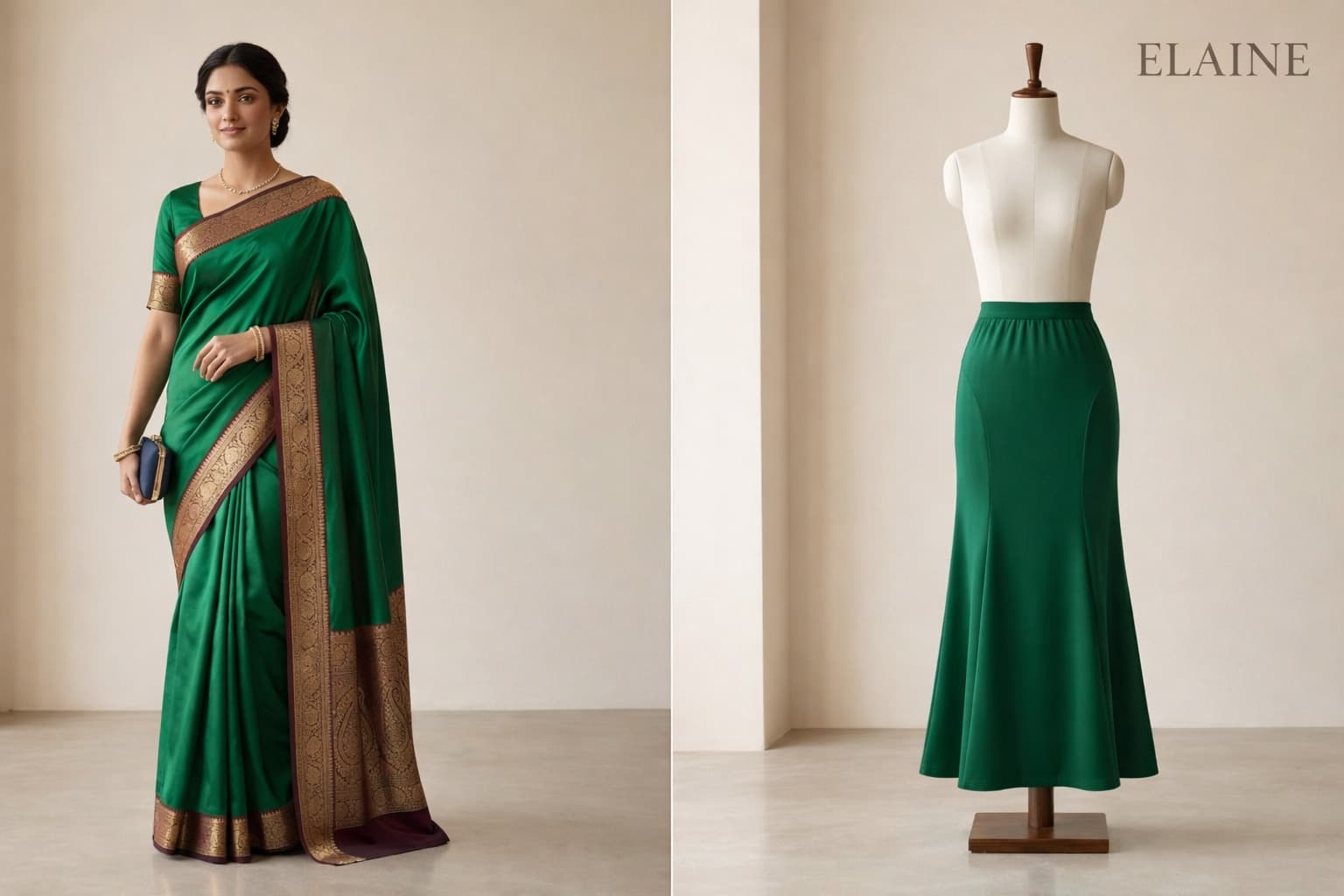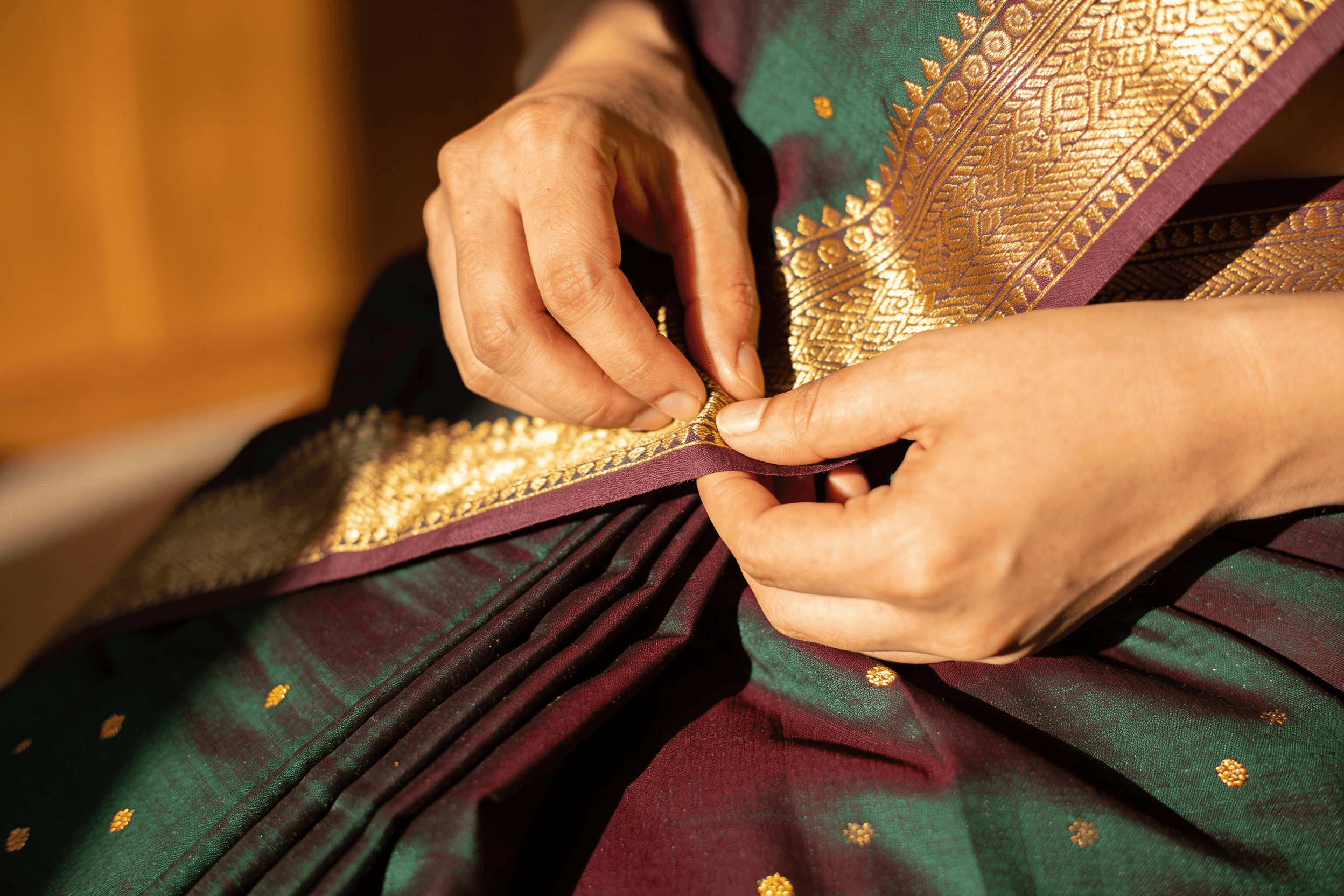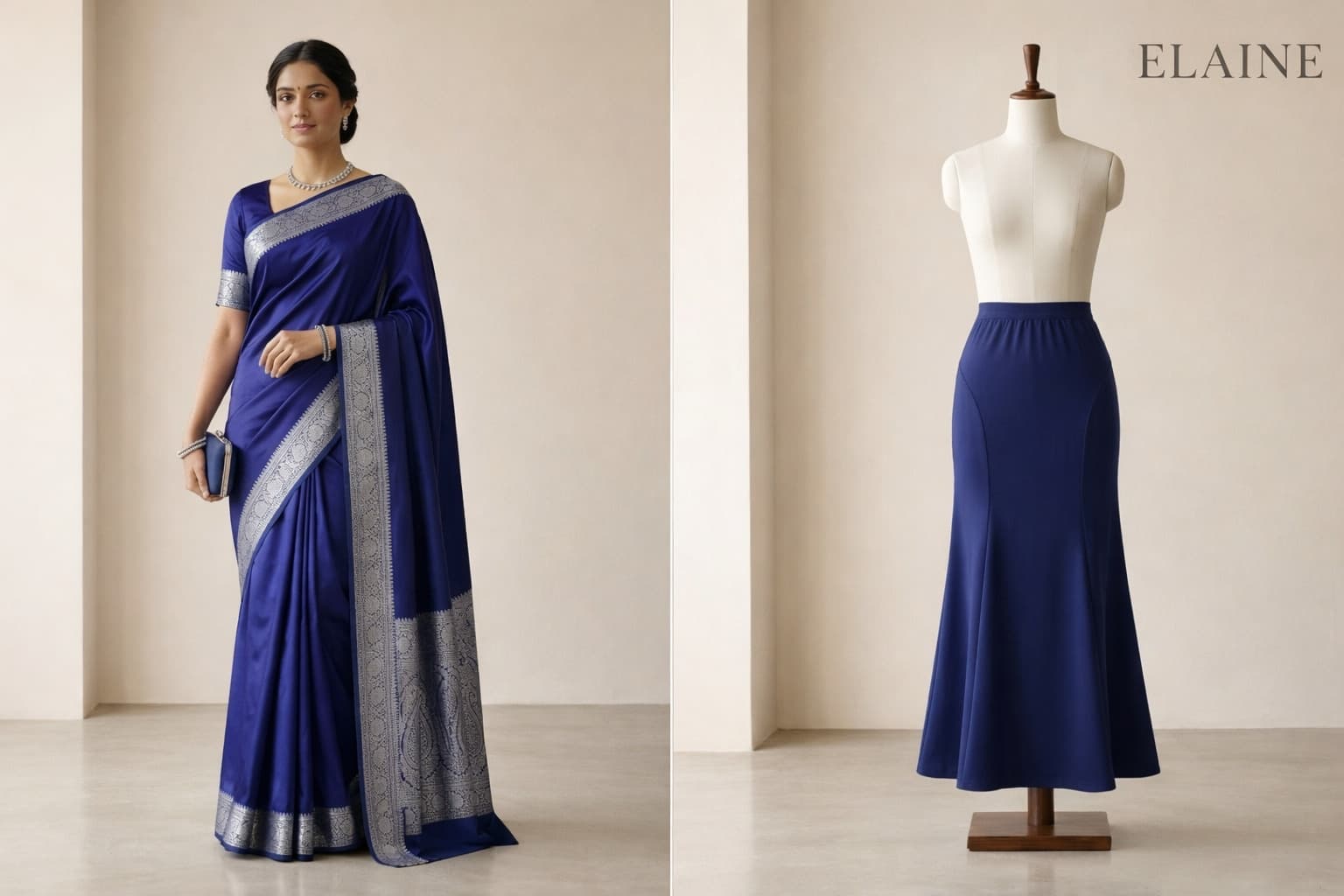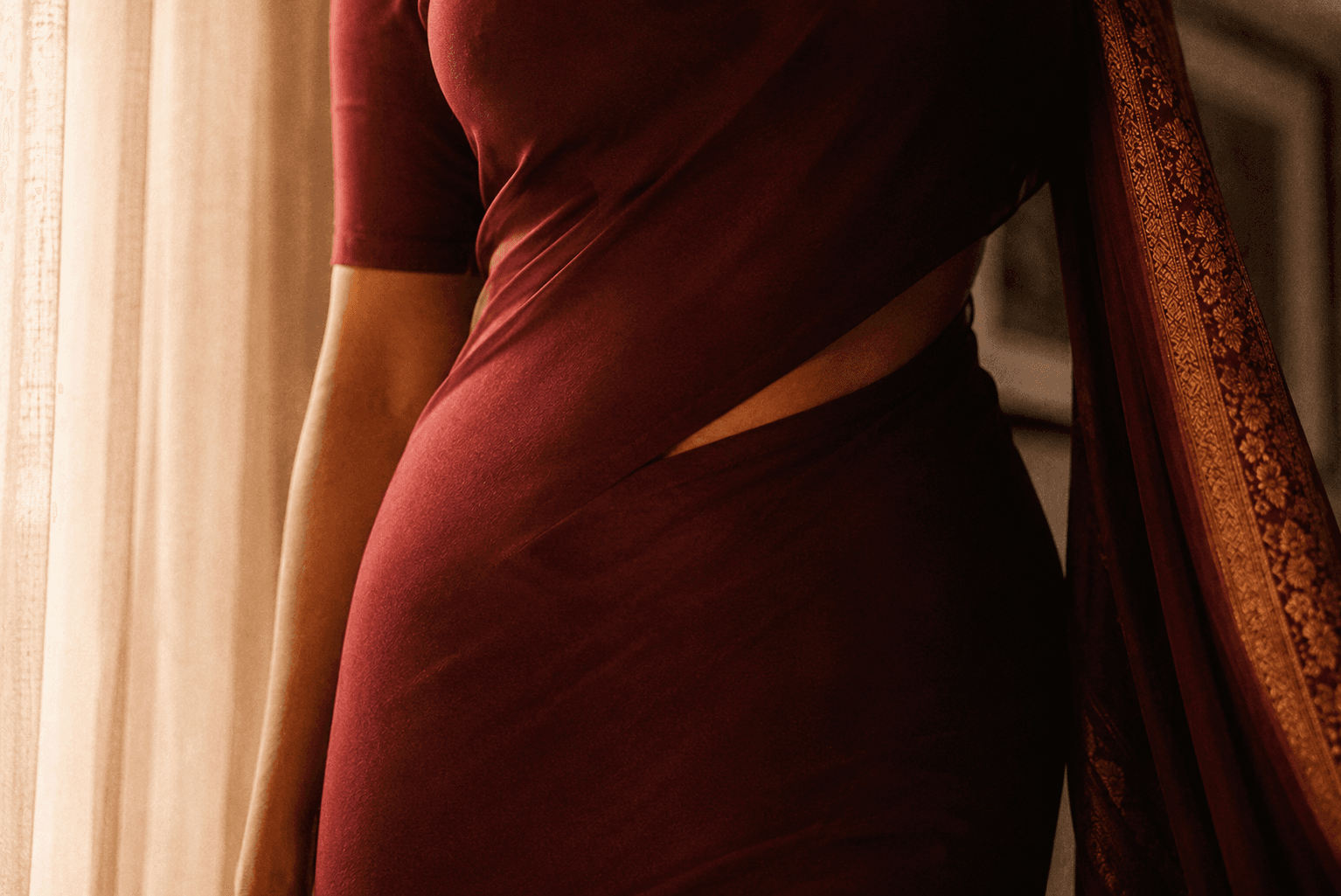
Yes — but a body-hugging saree asks something different of shapewear than a traditionally draped one does.
A regular saree has pleats, a pallu, and several layers of fabric that create their own structure. A body-hugging or fitted saree — the kind styled close to the body, sometimes with a mermaid-cut petticoat or a pre-stitched silhouette — has almost none of that forgiveness. Every line underneath shows. Every ridge, every seam, every place where two fabrics meet is visible through the saree rather than hidden by it.
This is a real, specific question, and it deserves a real, specific answer — not a vague reassurance.
Why a Body-Hugging Saree Is a Different Problem
A draped saree is, in a sense, self-correcting. The pleats add volume and structure that masks minor irregularities underneath. A fitted saree removes that buffer entirely. The saree sits directly against the shapewear, the petticoat, and the body — which means the base layer is doing all the work that the drape used to share.
This changes three things:
Seams become visible. Any raised seam on standard shapewear will show as a faint line through a fitted saree, especially in lighter colours or under photography lighting.
Texture becomes visible. Compression fabric with a textured or patterned weave can show subtly through fine fabric, even when the seams are flat.
Transitions become visible. Where the shapewear ends and bare skin or the petticoat begins, a fitted saree will show the change unless that transition is smooth.
None of this means a body-hugging saree can't be worn comfortably and confidently. It means the shapewear underneath has to be chosen with more precision than it would for a regularly draped saree.
What Actually Works Under a Fitted Saree
Seamless construction — non-negotiable here.
For a draped saree, seamless is a nice-to-have. For a fitted saree, it's the difference between invisible and visible. Look specifically for shapewear described as "seamless" or "laser-cut" — both terms refer to construction without raised stitching at the edges.
A smooth, even compression surface.
Avoid shapewear with a textured or ribbed weave, even if it's seamless at the edges. A flat, smooth knit performs best under fine or fitted fabric because it doesn't create any surface variation for the saree to reveal.
A gradual waist-to-hip transition.
Fitted sarees follow the natural line of the body closely. Shapewear that creates a hard edge at the waist — where compression suddenly stops — will show as a visible ridge under the fabric. Shapewear designed with a graduated compression zone, easing rather than cutting off at the waist, sits more naturally under a fitted silhouette.
Skin-tone matching, especially at visible edges.
Any point where the shapewear might be glimpsed — near the blouse line, at the slit of a fitted petticoat — should be in a tone close to your complexion, not a stark white or black that creates contrast against the skin.
On the Question Underneath the Question
Some women ask this question while also asking something else: whether shapewear can help them feel comfortable in a fitted saree regardless of their body shape or size — including after weight changes, after pregnancy, or simply because their body doesn't match what they've been told a "saree body" should look like.
We want to answer that directly, because the question deserves more than a deflection.
There is no body that a fitted saree is "for." A body-hugging saree drapes according to the fabric, the cut, and the base layer underneath — not according to a particular shape. The role of shapewear here is not to change what your body looks like. It's to give the saree a smooth, stable surface to sit against, so the saree does what it's designed to do — drape — regardless of your size.
In conversations with women about wearing sarees for long events, the discomfort that came up again and again wasn't about appearance. It was about managing the outfit — the constant awareness of whether something was sitting right, showing, or shifting. That awareness is exhausting regardless of body size. The right shapewear doesn't change your body. It removes the need to keep checking.
If a fitted saree feels intimidating, that's not a reflection of whether your body is right for it. It's a reflection of whether the base layer underneath is doing its job.
What to Avoid
Heavily structured shaping shorts or bodysuits with thick panels. These are built for under-garment compression, not for invisibility — exactly the wrong priority for a fitted saree.
Anything with decorative stitching or lace trim. Lace edges, however pretty, create texture that shows through fine fabric.
A size chosen for extra compression rather than correct fit. Sizing down to feel "held in" more tightly often creates more visible bulging at the edges of the shapewear — the opposite of the smooth result a fitted saree needs. Correct sizing, not smaller sizing, gives the smoothest result.
By Fabric Weight
Lightweight fitted sarees (georgette, chiffon, crepe)
The most demanding case. Only the thinnest seamless shapewear in a skin-tone match will be truly invisible. Avoid any compression style described as "firm control" — the firmer the compression, the more likely it is to create visible texture under very fine fabric.
Medium-weight fitted sarees (satin, silk blends)
Slightly more forgiving. Standard seamless shapewear with smooth, flat compression performs well. The fabric has enough body to soften minor irregularities.
Heavier fitted sarees (raw silk, structured weaves with a fitted petticoat)
The most forgiving of the three, though seamless construction still matters at the waist and hip line where the fabric sits closest to the body.
Frequently Asked Questions
Is shapewear suitable for a body-hugging saree?
Yes. A body-hugging saree requires seamless shapewear with smooth, even compression and no raised edges, since the saree sits close to the body and reveals texture that a draped saree would hide.
Can I wear shapewear under a fitted saree regardless of my body size?
Yes. Shapewear works the same way for every body size — it provides a smooth, stable base layer. It doesn't change body shape, and a fitted saree isn't suited to one particular body type. The right shapewear simply helps the saree drape evenly for any body.
What shapewear is best for a body-hugging saree with belly concerns?
High-waist seamless shapewear with graduated compression — firmer at the centre, easing toward the waistband — provides a smooth, stable surface without creating a hard line at the edge of the garment. The goal is an even surface, not maximum tightness.
Does shapewear show under a tight or fitted saree?
Only if it has raised seams, textured fabric, or a hard compression edge. Smooth, seamless, skin-tone shapewear with a graduated waistband is designed specifically to avoid this.
What is the difference between shapewear for a draped saree and a fitted saree?
A draped saree's pleats and layers provide their own structure, which forgives minor irregularities underneath. A fitted saree has no such buffer — every seam, texture, or transition shows. Fitted sarees require more precise, seamless shapewear than draped ones.
Is a body-hugging saree harder to wear than a regular saree?
It requires more attention to the base layer, but it isn't inherently harder. With the right seamless, smooth-compression shapewear underneath, a fitted saree can be just as comfortable to wear for a full event as a traditionally draped one.
Read next: Can You Wear Shapewear Under a Saree? · Which Shapewear is Best for a Saree? · Why Your Shapewear Keeps Rolling Down