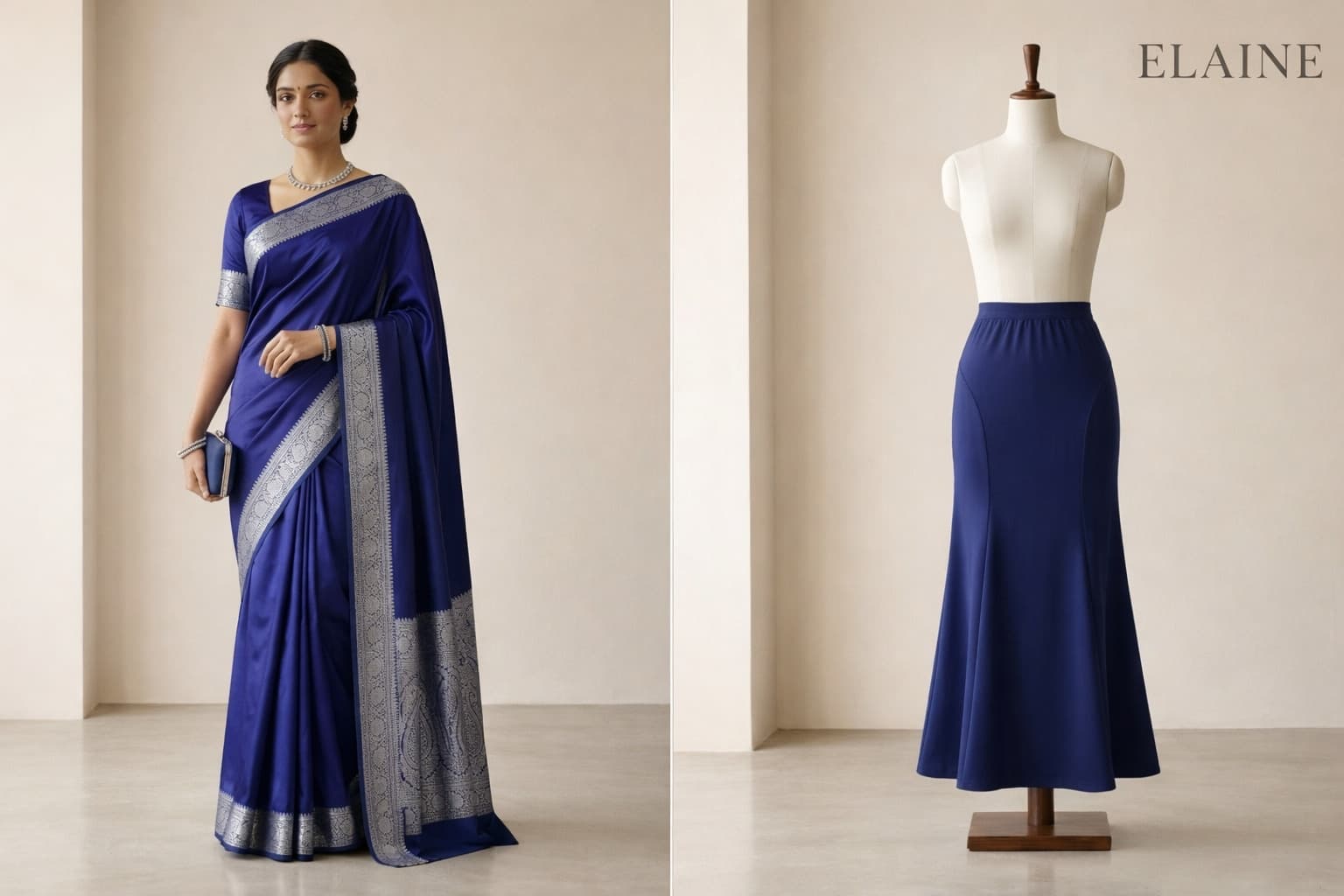
The problem with plus size shapewear and sarees is not that options don't exist. It is that much of what exists was designed around fitted Western garments — a bodycon dress, a pencil skirt, a formal trouser — where the outer garment itself holds the shapewear in place and creates additional external pressure against the body.
A saree works differently. The saree fabric itself does not provide continuous, body-hugging pressure around the shapewear. Its stability comes from the petticoat, the waist fastening, and the shapewear's own construction. Under a fitted dress, the garment compensates for a shapewear waistband that is slightly too loose or lightly constructed. Under a saree, there is nothing to compensate. The shapewear holds because of what it is built to do — or it doesn't.
This is why plus size shapewear that works under a dress can roll, shift, and become the primary experience of a wedding by the time the first round of photographs is done. The saree was not the problem. The construction was built for a different context.
Why Saree Wear Creates a Specific Plus Size Challenge
Three things compound for plus size wearers specifically.
The waistband carries a different load. A heavier saree fabric increases the forces acting around the waist and the underlying support layers. While the petticoat carries much of the saree's weight directly, the shapewear waistband underneath still needs to maintain its position and compression through hours of sitting, standing, bending, and walking. A lightly constructed waistband that holds through a two-hour event may not hold through an eight-hour wedding.
Size charts vary significantly at the upper end. Size availability across Indian-market saree shapewear varies considerably by brand and product. Some products extend well into larger sizes with detailed measurement ranges; others have much narrower size charts. The issue is not always availability — it is finding a product whose published measurement ranges map correctly to your specific proportions. A woman with a 95cm waist and 118cm hip, for example, may find that a particular brand's size chart does not accommodate both measurements cleanly in a single size. The relevant question is the measurement range of the specific garment, not the label on the product page.
Duration amplifies everything. An Indian wedding or festival occasion runs for many hours. Shapewear that is incorrectly sized or lightly constructed may be manageable early in the day and progressively uncomfortable by the afternoon. At larger sizes, where waistband circumference is wider and load demands are higher, the margin for construction error is smaller. The practical question before any long occasion is: has this held through two hours at home under normal movement? If not, it will not hold through a full day.
What Plus Size Shapewear for Sarees Actually Requires
Waistband construction — what to look for
Waistband width and waistband stability are not the same thing. A wider elastic band distributes surface pressure over more skin but does not necessarily add structural hold. When evaluating a waistband, the useful questions are: how firmly does it grip during movement, does it roll when you sit and stand repeatedly, and does the brand provide specific construction information — inner banding, grip finish, structured edge — separately from the compression body? A waistband described only in terms of width or coverage has not necessarily been engineered differently from the rest of the garment. For saree wear, waistband stability is worth treating as the primary construction requirement.
Sizing from measurements, not from labels
Label sizes are not standardised across shapewear brands. Two products both labelled XXL may have hip ranges that differ by 10cm or more. The only reliable approach is measuring your natural waist and full hip in centimetres and comparing those numbers directly to a brand's measurement-based size chart. If a brand's size chart gives measurements only in kilograms or generic label sizes without centimetre ranges, it does not give you enough information to size from reliably.
How to measure: natural waist at the narrowest point of your torso, as specified by the brand's sizing guide, and hip at the fullest point of the hips and buttocks, keeping the tape level and not pulled tight. The full sizing methodology, including the fit tests that apply before any long occasion, is in the saree shapewear sizing guide.
If your measurements fall between two sizes, the larger size is often the safer starting point for a long occasion — but follow the brand's own guidance if it addresses this. The difference in compression between adjacent sizes is not always marginal, and the right choice depends on the garment's construction and intended compression level.
Compression calibrated to the occasion, not to maximum hold
For a long occasion, sustained comfort matters as much as compression level. A garment that provides adequate support without excessive pressure is usually easier to wear through a full day than one at maximum compression. At plus sizes, where the garment covers more body surface area in warmer conditions, very high compression can concentrate heat and create pressure marks that become progressively harder to ignore. The practical goal is a garment that does its job without announcing itself.
What about tummy-focused shapewear?
Many plus size shapewear descriptions lead with tummy control as the primary feature. For saree wear, tummy control should not be treated as the only performance criterion. The saree pallu and pleats create their own visual line across the front of the body. Waist stability, hip coverage, comfort across hours of wear, and resistance to shifting may matter just as much — sometimes more. A shapewear piece engineered primarily around front-panel compression at the expense of waistband structure may not hold its position through a long occasion regardless of how it feels in the first hour. The more useful question is not "does this control the tummy" but "does the waistband hold and does the coverage stay in place."
Full coverage from waist to mid-thigh
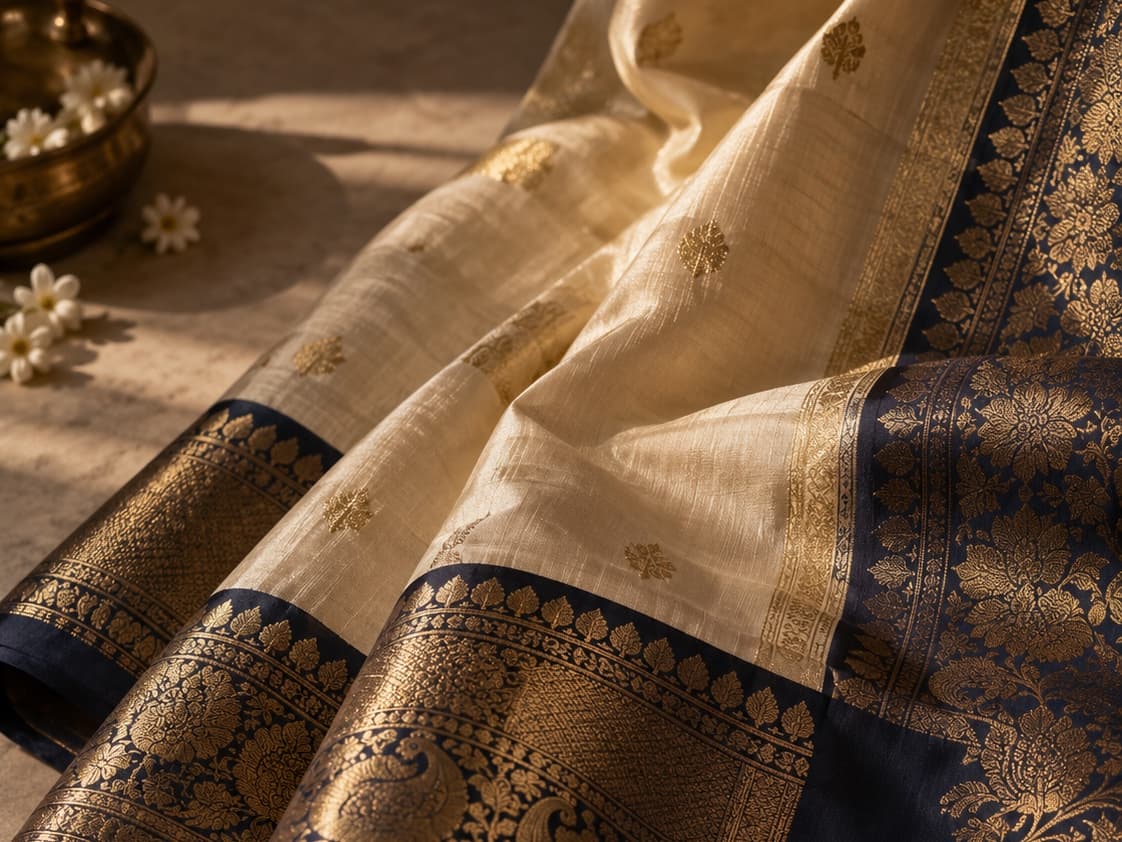
For many sarees — particularly lightweight or body-skimming fabrics — high-waisted shapewear extending to the mid-thigh reduces visible compression edges when walking. The appropriate length depends on the saree fabric, the drape, and the wearer's own comfort. For structured, opaque fabrics like Kanchipuram or Banarasi silk, the length is less critical because the saree covers the transition. For lighter fabrics — georgette, chiffon, satin — shapewear that is too short at the thigh can create a visible compression line. Check both circumference and length in the size chart before purchasing.
Fabric and Climate: What to Consider at Plus Sizes
Fabric construction affects moisture management and air movement — and at plus sizes, where more body surface area is covered, this matters more across a long occasion.
Fibre content is not the whole story. Cotton-blend shapewear can offer useful moisture-management characteristics for warm-weather wear. But breathability depends on the fibre blend, knit construction, fabric weight, thickness, and porosity — not on fibre content alone. Some synthetic constructions are specifically engineered for moisture transport and can perform well in warm conditions. The label "cotton blend" is a starting point, not a guarantee.
For Indian summer and monsoon occasions, fabric construction that allows moisture movement is worth prioritising — whether that is a cotton-blend or a well-constructed synthetic with moisture-wicking properties. The key is heat and moisture management across several hours, not the fibre percentage on the label.
For cooler venues or winter occasions, fabric breathability is a less critical factor and nylon-spandex or silk blend constructions can be considered alongside other variables: stretch recovery, surface smoothness, compression level, and durability.
For body-hugging fabrics — georgette, chiffon, satin — seamless construction without raised seam edges is worth prioritising at any size. Raised seam edges are more visible under lightweight clingy fabrics than under structured silks. The full guide for body-hugging fabrics is at shapewear for a body-hugging saree.
The complete climate and fabric guide is at shapewear in Indian heat and humidity.
How to Wear Shapewear Under a Saree
The order of dressing matters — particularly at plus sizes where layering affects both comfort and how the shapewear holds through the day.
Shapewear goes on before the petticoat. The petticoat sits over the shapewear, not underneath it. This keeps the shapewear held against the body by both its own waistband grip and the petticoat above it, rather than forcing the saree to drape directly over the compression garment.
Check the waistband position before adding any other layer. The waistband should sit at the natural waist — the same height where the petticoat string will be tied. If the shapewear waistband has already shifted during dressing, adjust it before the petticoat goes on. It will not correct itself once both layers are in place.
Check that the waistband is lying flat. Run your hand around the full circumference before tying the petticoat. Any rolling or folding at this stage should be addressed now.
Drape the saree normally over the petticoat. Once both layers are in position, the saree drapes over the petticoat in the usual way. The shapewear should remain comfortable and in position during normal movement. If you are constantly aware of it while draping or walking, reassess the sizing or positioning before the occasion.
The full comparison of how shapewear and petticoat work together as a system is in shapewear vs petticoat for a saree.
How to Assess Fit Before Buying
Measure first. Measure your natural waist and full hip in centimetres. Compare to a size chart that gives centimetre ranges for each size. If the chart gives only label sizes or weight ranges without measurement data, find the specific centimetre ranges before purchasing.
Between sizes — follow the brand's guidance. If the brand doesn't address this, the larger size is often the more comfortable starting point for a long occasion, but this depends on the garment's construction and compression level.
Check waistband information specifically. Look for construction information about the waistband separately from the compression body. How it grips, whether it has internal structure, and how it behaves during movement are the relevant questions.
Wear it at home before the occasion. As a practical pre-event test, wear the shapewear for one to two hours at home, doing normal activities — sitting, walking, bending. A waistband that has shifted or rolled in two hours at home will not hold through a full occasion day.
Is It Worth Paying More for Reinforced Seams?
At larger sizes, the forces on seam construction can be substantial. A shapewear brief with standard sewn seams at the hip may create a visible ridge under body-hugging fabrics and may wear faster under higher stretch demands. Flatlock construction or bonded edges distribute stress more evenly and reduce the seam-visibility problem.
That said, seam construction is a secondary consideration relative to waistband construction and overall sizing. A shapewear piece with well-finished seams and an inadequate waistband will still fail to hold its position. Prioritise waistband construction and correct sizing first. Seam construction matters most for body-hugging, lightweight fabrics where any raised edge will be visible.
A Note on Elaine's Size Range
Elaine's current published size chart runs to XL. Extended sizing is part of what the first collection is being built toward. If you are outside the current published range, the collection page is where availability will be confirmed first when it is ready.
Frequently Asked Questions
Is there plus size saree shapewear in India?
Plus-size saree-specific options do exist, and availability has expanded. Size ranges and construction quality vary considerably between products. The useful approach is evaluating the specific garment: does it provide a measurement-based size chart, does it describe waistband construction specifically, and does it cover from the natural waist to a length that works with your saree fabric and drape?
What is the difference between plus size and standard shapewear sizing?
The measurement methodology is the same — natural waist and full hip in centimetres compared to a brand's size chart. The construction requirements change at larger sizes because the waistband needs to hold across a wider circumference and the garment covers more surface area. A waistband that holds at a smaller size may not hold at a larger one if it was not built with that load in mind. Measurement-based sizing, and specific attention to how the waistband is constructed, both matter more at larger sizes.
How do I find plus size saree shapewear that fits true to size?
Measure your natural waist and full hip in centimetres. Compare those measurements to the brand's size chart — the chart should give centimetre ranges for each size, not just label names. If the chart uses only weight ranges or generic S/M/L/XL labels without centimetre data, it does not give you enough information to size accurately. The full measurement process is in the sizing guide.
Why does my plus size shapewear keep rolling down under a saree?
The most likely causes are waistband construction — a waistband without adequate structure may not hold across a wider circumference under the additional load of a heavy saree — and sizing, where a garment that is too small tries to maintain compression at a circumference it was not built for and rolls to relieve that tension. Check your measurements against the size chart and look for specific waistband construction information before purchasing. The full mechanics of rolling and how to address it are in why shapewear rolls down.
Is cotton plus size saree shapewear better for Indian occasions?
Cotton-blend shapewear can be worth considering for warm-weather occasions because cotton-containing fabrics often have useful moisture-management characteristics. But breathability depends on the fabric's construction, weight and porosity — not on fibre content alone. Some synthetic constructions are specifically engineered for moisture transport and can perform well in warm conditions. Choose by fabric construction for the specific conditions, not by fibre label alone.
Does plus size shapewear show under a saree?
Under structured, opaque sarees — Kanchipuram silk, Banarasi, cotton — seam construction is generally not visible. Under body-hugging fabrics — georgette, chiffon, satin — seamless or flatlock construction is worth prioritising at any size. Coverage length also matters: shapewear that is too short at the thigh can create a compression edge visible under lightweight fabrics when walking. Check both circumference measurement and length coverage before buying. The full guide for body-hugging fabrics is at shapewear for a body-hugging saree.
Is plus size shapewear comfortable for a full Indian wedding day?
With the right construction and sizing, yes. The practical requirements: a waistband that holds at your specific circumference across movement over several hours, compression calibrated to sustained comfort rather than maximum hold, coverage that stays in position throughout the day, and sizing from your actual measurements rather than from label sizes. Shapewear that meets these criteria is wearable across a long occasion. Shapewear that misses any one of them tends to become progressively harder to ignore as the day goes on.
What is a shapewear petticoat for saree, and does it work for plus sizes?
A shapewear petticoat combines petticoat and shapewear into a single garment. For plus sizes, the same construction principles apply: the waistband needs to hold at your specific circumference and the garment needs to provide coverage appropriate to your saree fabric. One advantage of wearing separate shapewear under a standard petticoat is that each layer can be sized independently — the shapewear to compression requirements, the petticoat to draping requirements. They do different jobs and sizing them separately gives more control over each. The full comparison is in shapewear vs petticoat for a saree.
Read next: How to Choose Your Saree Shapewear Size · Why Shapewear Rolls Down (And the Real Fix) · Shapewear for a Body-Hugging Saree: What Actually Works · Shapewear in Indian Heat and Humidity: What Actually Works · Shapewear vs Petticoat for a Saree: Why the Answer Is Usually Both