What Is a Chanderi Saree?
Chanderi is a handloom textile from the town of Chanderi in Madhya Pradesh, with a weaving tradition generally traced back around seven centuries. It has been registered as a Geographical Indication since 2005, which protects the geographical identity of Chanderi sarees produced in the region. The craft has GI registration number 7 in India's IP registry.
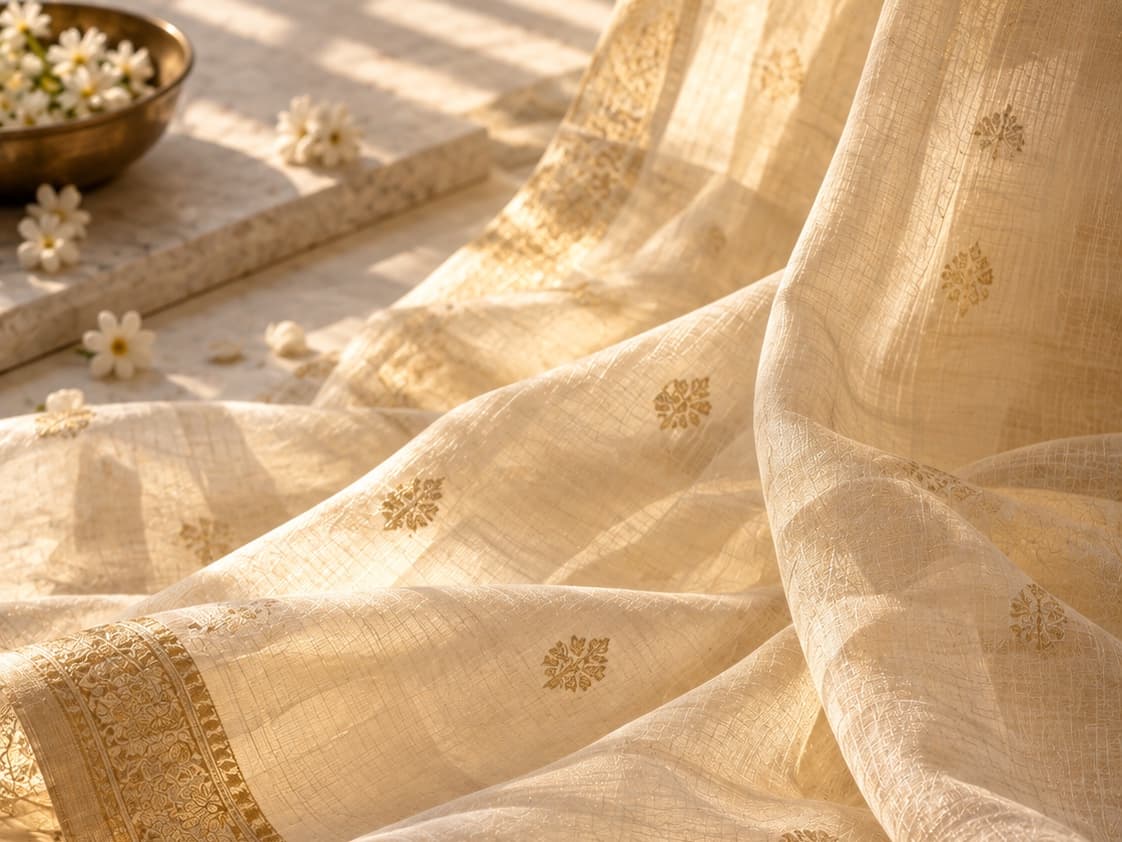
Chanderi sarees are made using different combinations of silk and cotton yarns — silk warp with cotton weft, silk throughout, cotton throughout, and variations in between. The exact fibre combination varies by piece and affects the fabric's handle, sheen, and how it drapes. What most Chanderi sarees share, regardless of fibre combination, is a fine, lightweight construction that is often poetically described as woven air — a reference to how little weight the fabric carries and how freely it moves.
The other defining characteristic of Chanderi is its traditional motifs: small handwoven butis of florals, peacocks, coins, and geometric shapes, typically worked into the body of the saree and bordered by zari in gold or silver. In traditional handwoven Chanderi, these butis are woven into the fabric using supplementary weft techniques. Contemporary market Chanderi also includes printed versions — so if the source of the saree matters to you, it is worth checking whether the motifs are woven or printed before purchasing.
What Does Sheer Mean, and Why Does It Matter Here?
Sheer means the fabric has a degree of transparency — light passes through it, and what sits underneath can be partially visible through the weave.
This is what separates Chanderi from heavier ceremonial silks as a dressing problem. Under an opaque saree like Kanchipuram or Banarasi, the fabric is a barrier — the concern is whether a seam edge or waistband ridge presses through the surface from the outside. Under a translucent Chanderi, the fabric itself is not a full barrier. The colour and surface of what sits underneath can influence how the saree appears, particularly in strong light and in photographs.
How much shows through depends on the specific saree — not just the label. Sheerness in Chanderi is determined by yarn fineness, weave density, the colour of the fabric, the density of the motifs, and the construction. A pale, plain-bodied Chanderi with widely spaced butis can be considerably more translucent than a densely patterned, deeper-coloured one. Two sarees both called Chanderi can behave very differently in terms of what they reveal underneath.
The most useful test before choosing what to wear underneath: hold the saree up to daylight and look at the plainest section of the body. What you can see through the fabric in that moment is what will be visible when you are wearing it.
That test tells you more than the fibre label does.
How Motifs Affect Visibility
Traditional Chanderi butis — the small handwoven motifs of peacocks, florals, coins, and geometric shapes — are worked into the fabric using supplementary weft threads. These areas introduce additional yarn into the weave and can provide more visual coverage than the plain ground around them.
This has a practical implication for what you wear underneath. A Chanderi with closely spaced butis across the full body of the saree has more patterned area and less exposed plain ground. As a practical matter, more densely patterned sarees tend to make the underlying layers less visually obvious than a largely plain, translucent body would.
A saree with widely spaced butis or a predominantly plain body — where the pattern is concentrated in the border and pallu, and the body is mostly unworked — exposes more of the plain, translucent ground. That is where colour contrast and construction edges are most likely to be noticed.
Assess the buti density of the specific saree alongside the light test. They tell you the same thing from two angles.
Colour: The First Decision
For a translucent Chanderi, colour is one of the first things to consider — before compression level, before construction type.
The shapewear and skin. If the aim is to make the shapewear visually unobtrusive through a translucent fabric, a shade close to the wearer's skin tone is usually the most effective choice. The shapewear is visible through the fabric as a skin-adjacent layer. A shade that reads as continuous with the skin disappears; a shade that contrasts with the skin reads as a separate layer underneath, regardless of how well it matches the saree.
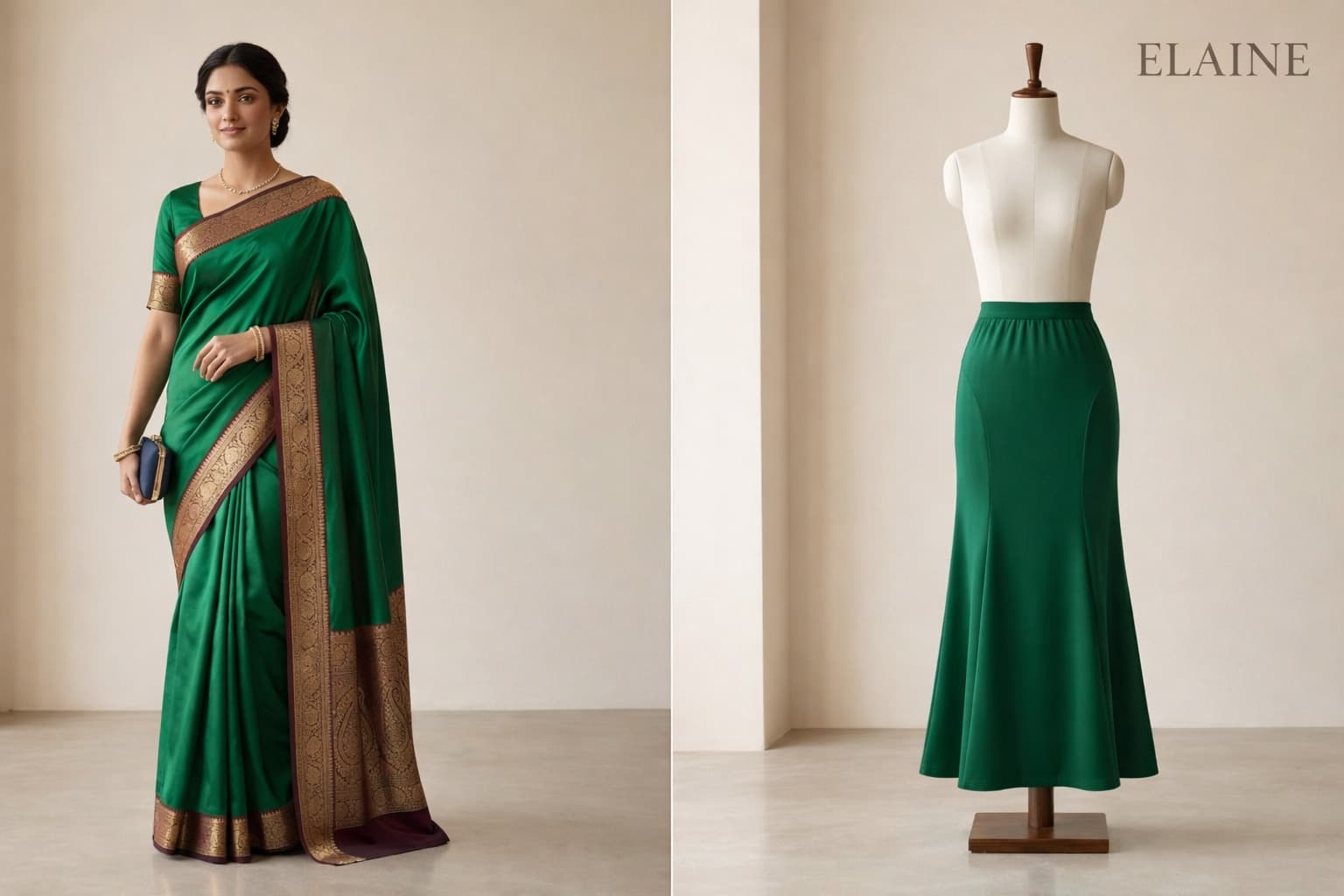
The petticoat and the saree. The petticoat operates differently. For a translucent Chanderi, a petticoat close to the saree's base colour is a useful default — it minimises the chance of an unintended colour shift in the drape, particularly at the hip and thigh where the fabric falls freely. This is most relevant for deeper-toned Chanderis where a white petticoat would read as a visible lighter layer beneath.
Two separate colour decisions, for two separate layers, for two separate reasons. Neither is an absolute rule — but both are worth making deliberately rather than by default.
What to Wear Under a Chanderi Saree
A smooth, low-profile construction
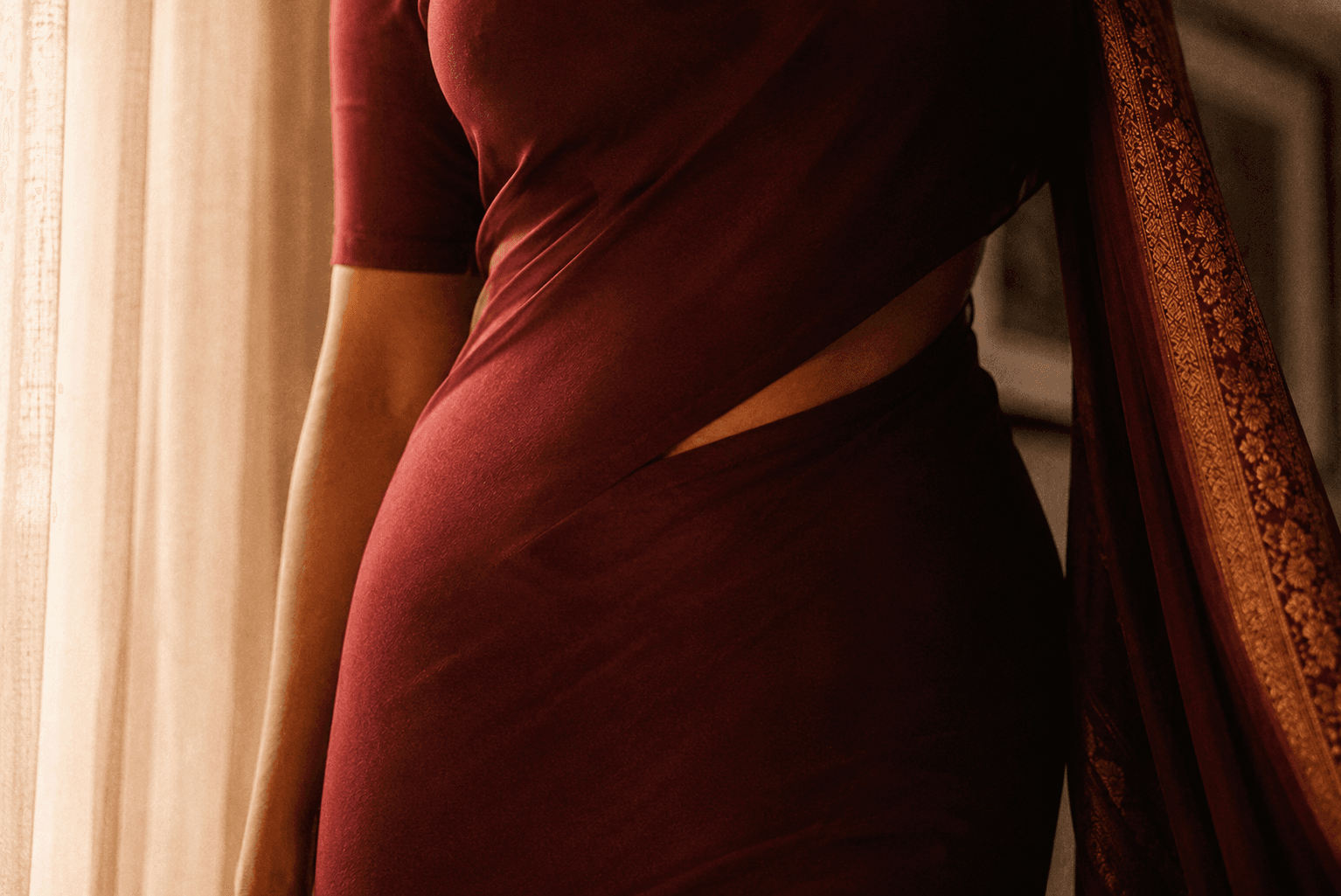
Under a translucent fabric, surface texture is visible before compression level is. Raised seam edges, stitched borders, ribbing, and textured surfaces can all be noticeable through a sheer weave. Seamless construction is one way to achieve a smooth surface — flatlock or carefully bonded seams are others. The goal is the same: a garment with no raised edges that create a visible line through the fabric.
In a shade close to your skin tone
The colour match applies regardless of construction type. A smooth, skin-tone-matched garment is less likely to create a visible transition than a contrasting or heavily textured one under translucent Chanderi.
Light to medium compression for active occasions
Chanderi is a festive, movement-oriented fabric — Diwali, Navratri, receptions. For an active occasion, light to medium compression may be preferable if comfort and freedom of movement are priorities. Firm compression is not inherently inappropriate under Chanderi, but for several hours of active festive wear, a garment calibrated to sustained comfort is worth considering.
High waist, waistband and petticoat at the same height
Keeping the shapewear and petticoat waistlines close together reduces the chance of overlapping edges or visible transitions at the waist, which can be noticeable through a translucent fabric.
A flat waistband edge
Even a stable, non-rolling waistband can create a horizontal line through Chanderi if the waistband edge is raised rather than flat. The edge of the waistband should be as smooth as the rest of the garment.
What to Consider Avoiding
Strongly contrasting shapewear if your goal is invisibility through a translucent saree. Colour contrast is more immediately noticeable than construction detail.
Highly textured or ribbed shapewear where the texture is visible through the specific saree — assess this with the light test on your particular piece.
Very firm compression if it restricts movement or causes discomfort during an active occasion.
A strongly contrasting petticoat if you want the saree to retain a uniform colour appearance — most relevant for deeper-toned Chanderis.
Low or mid-rise shapewear where the waistband sits below the petticoat, creating overlapping pressure points at the waist.
For Specific Chanderi Occasions
Diwali. Active evening — visiting, photographs, movement across several hours. Light compression, smooth low-profile construction, skin-tone matched, breathable. Prioritise invisibility and comfort through activity.
Navratri. Sustained movement and dancing. Prioritise a well-fitted garment that stays in place without requiring repeated adjustment. Colour match and waistband stability are the two most relevant considerations.
Semi-formal occasions and receptions. Moderate duration, less movement. The same colour and surface considerations apply, with standard light compression.
Daytime or warm outdoor settings. For warm occasions, fabric construction that allows moisture movement is worth considering. Lightweight constructions with good moisture and air-transfer properties are preferable — cotton blends are one option, but fabric weight and construction matter alongside fibre content.
Frequently Asked Questions
What do you wear under a Chanderi saree?
A smooth, low-profile construction in a shade close to your skin tone, at light to medium compression, with a flat waistband edge. Under a translucent Chanderi, colour and surface smoothness deserve attention alongside compression level — the light test on your specific saree will tell you how much care each requires.
What does sheer mean in a Chanderi saree?
Sheer means the fabric has a degree of transparency — light passes through it, and what is underneath can be partially visible. How sheer a particular Chanderi is depends on the yarn, weave density, colour, motif density, and construction of that specific saree, not on the fibre label alone. The simplest way to assess it is to hold the saree up to daylight and look at the plainest section of the body.
What colour shapewear under a Chanderi saree?
If the aim is to make the shapewear visually unobtrusive, choose a shade close to your skin tone rather than trying to match the saree. The shapewear is visible through the fabric as a skin-adjacent layer — a match to skin reads as invisible; a contrast to skin reads as a separate layer underneath.
What petticoat is best for a Chanderi saree?
A petticoat close to the saree's base colour is a useful default for a translucent Chanderi — it minimises unintended colour shifts in the drape. A white petticoat works under pale or ivory Chanderi. For deeper or more saturated Chanderi, a colour-matched petticoat reduces the visibility of the petticoat layer through the drape.
Do the motifs on a Chanderi saree affect what you wear underneath?
Yes, as a practical observation. Handwoven Chanderi butis introduce additional yarn into small areas of the fabric and can provide more visual coverage than the plain ground around them. A Chanderi with closely spaced butis across the full body tends to make the underlying layers less visually obvious. A saree with widely spaced motifs or a predominantly plain body exposes more plain, translucent ground and requires more care with colour matching.
What is the difference between the different types of Chanderi?
Chanderi is made with different combinations of silk and cotton yarns, and the fibre combination affects the fabric's handle, sheen, and drape. But sheerness — how translucent the fabric is — is not simply a function of which fibre is used. Yarn fineness, weave density, colour, motif density, and construction all contribute. The most reliable way to assess how translucent a specific Chanderi is, is to hold it up to daylight and look at the plainest section of the body.
Are Chanderi motifs always woven?
In traditional handwoven Chanderi, butis are created using supplementary weft techniques — they are woven into the fabric, not printed on it. Contemporary market Chanderi also includes printed versions. If authenticity matters to you, check whether the motifs are woven or printed before purchasing.
Is Chanderi a body-hugging saree?
Chanderi is not inherently a body-hugging fabric. Its characteristic quality is its fine, lightweight, translucent drape rather than a clingy fit against the body. The translucency is the primary consideration for what you wear underneath — not the closeness of the drape. The full guide to which saree fabrics are body-hugging is at which saree fabric is body hugging.
Do I need shapewear under a Chanderi saree?
Not necessarily. A correctly fitted, appropriately coloured petticoat can be sufficient depending on the saree and the occasion. For longer or more active occasions, some wearers prefer shapewear for additional support. The decision depends on the occasion's duration, how active it is, and the specific Chanderi's translucency.
Read next: What to Wear Under a Kanchipuram Silk Saree · Which Saree Fabric Is Body Hugging? · Shapewear in Indian Heat and Humidity: What Actually Works · What to Wear Under a Banarasi Saree